
Family Estrangement Therapy: How Schema Therapy Helps Clients Decide Whether to Cut Off or Reconnect

Shreya opened her first session of family estrangement therapy by reading me a text. She had sent it to her mother at 11:40 the night before. “I need space. Please don’t contact me until I reach out.” Although Shreya is a teaching case I created for this article, not a real client, you have met her many times. Thirty-six, sharp, tired. She set the phone face down on her knee and asked the question every clinician in this work hears eventually.
“Tell me I did the right thing.”
I wanted to. Her mother, Rekha, had spent twenty years commenting on Shreya’s weight, her job, her partner, and her tone when she objected. Saying yes would have been kind, and it would have been a guess. What I could not tell yet was who had sent that text. Perhaps the adult who finally knew what she needed. Or a part of her that learned long ago to go cold and disappear when someone hurt her.
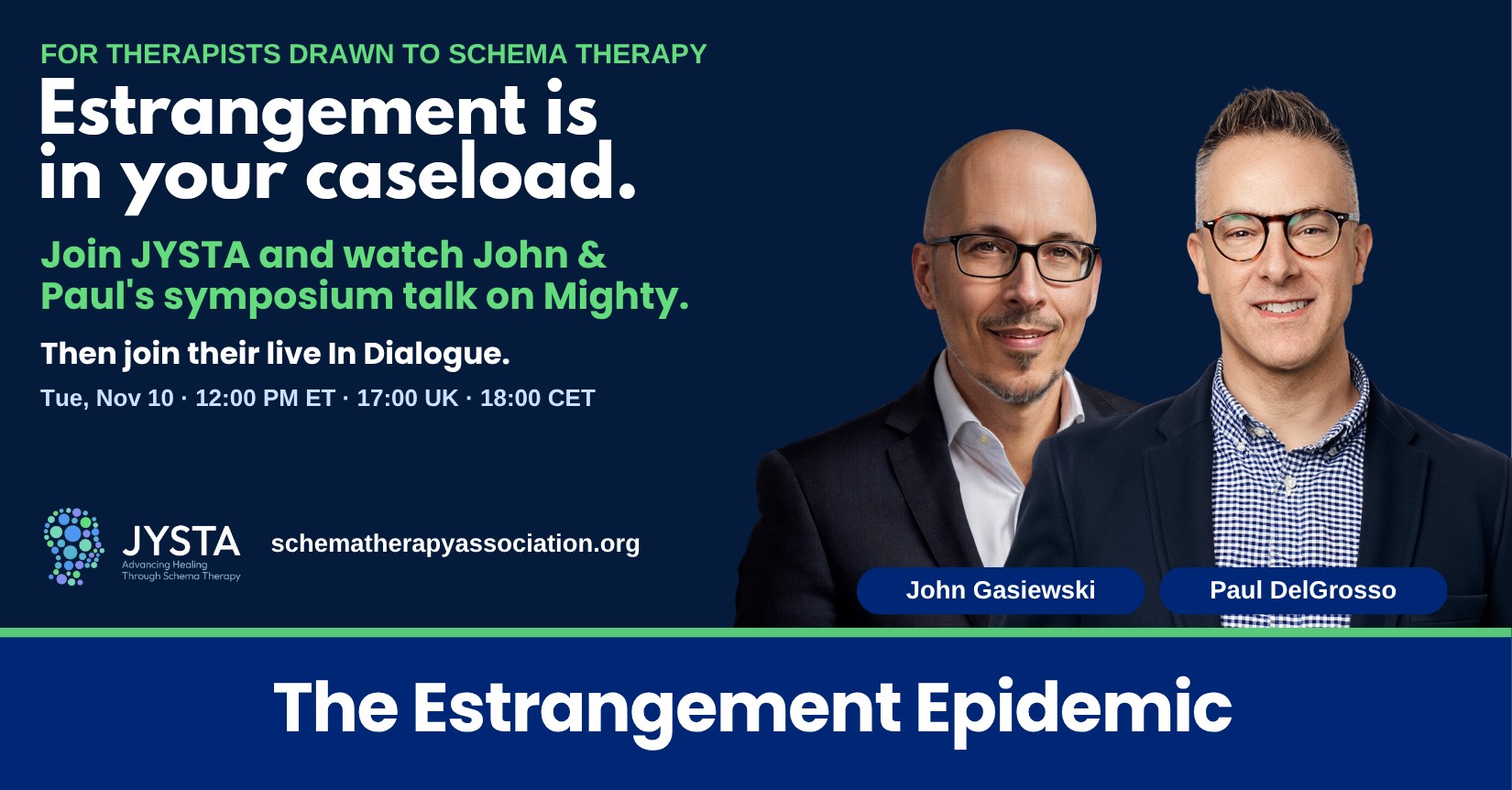
If you treat adults, young adults, or families, family estrangement is probably already on your caseload. Misread the case and you can bless a cutoff that keeps a client numb, or push a reunion that reopens old harm. Family estrangement sat at the center of a session at the Jeffrey Young Schema Therapy Association (JYSTA) symposium. John Gasiewski and Paul DelGrosso split their hour, The Estrangement Epidemic, into two halves on purpose. In the first, John made the case that estrangement can sometimes be a path to schema healing. Paul made the case for the work of reconciliation. Neither argued the other was wrong, which is part of what made it worth watching. Their recording is in the JYSTA Mighty Network, and they meet again live on November 10. What helps is a clear schema therapy formulation, a few experiential tools, and honesty about your own family story.
The short answer: before you support a cutoff or push for repair, find out which mode is closing the door.
- Two valid outcomes. Estrangement can protect schema healing; reconciliation can support it. The formulation helps clarify what the client needs.
- Safety first. Formulation assumes no current threat. When there is one, protective distance comes first.
- Inner critic versus parent. Schema therapy fights the internalized Punitive Parent; the living parent is a separate decision.
- Partial counts. For some clients, limited contact is the right outcome.
Why is family estrangement therapy so hard to get right?
Family estrangement therapy is hard because the therapist’s own history pulls on the case before the formulation is finished. Some of us grew up believing family is forever. Others learned that distance from family members was the only thing that worked. Either belief can steer a session quietly, which is why schema therapy’s structure helps.
The problem is not rare. A survey led by sociologist Karl Pillemer at Cornell University found that 27 percent of American adults had cut off a family member. In Great Britain, a 2014 Ipsos MORI survey for the charity Stand Alone put the figure at roughly one family in five. During the symposium, clinicians in the chat from Ireland to Ukraine said the same about the adult children and estranged parents they treat.
John described the literature as split into two camps. The larger one explains how family estrangement happens and holds out hope of reconciliation. Pillemer’s Fault Lines is his favorite. A smaller camp argues that estrangement is sometimes necessary for a person’s mental health and well-being. Eamon Dolan’s The Power of Parting, his account of leaving his mother in his forties, belongs there.
Your client has probably read one of those camps already. Shreya had read three books from the second.
John also asked a question I have since used in supervision. Is estrangement a taboo for you? Must the adult children you treat reconcile with their parents? Whatever your answer, it shows up in the room before you say a word.
When is family estrangement healthy, and when is it a coping mode?
From a schema therapy perspective, estrangement is more likely to reflect a Healthy Adult choice when the Vulnerable Child’s unmet needs can be felt rather than shut out. It works as a coping mode when the main job of the distance is to stop those feelings altogether. From the outside, the behavior can look identical. The state behind it is what differs. All of this assumes no current safety threat. When a parent is still abusive or dangerous, protective distance comes first, and the formulation can wait.

Paul offered his own name for the second version: the estranged protector. It is not an established schema therapy mode. Paul describes it as a shade of the Detached Protector, a state that cuts off the Vulnerable Child’s needs and feelings because of pain. It also urges distance from the family members who contributed to the schema, some of whom might be open to repair. In the established mode model, the closest fit is the Avoidant Protector. The Cambridge Guide to Schema Therapy describes it as avoiding any situation, person, conversation, or activity that could trigger vulnerable feelings. A parent is about as big a trigger as there is.
John came at it from the other side. Staying in the relationship, he argued, carries its own collateral damage. When every visit restokes the Punitive Parent, contact keeps confirming the schema. Self-esteem pays for it.
Both arguments fit Shreya. Rekha was harsh, and every visit left Shreya shaky for days. She described the night of the text in a flat, almost bored voice, and could not say what she felt. No anger, no guilt. Relief, and then nothing (Detached Protector). I made a note and kept listening.
The test I use is less about the decision and more about access to feelings. Can your client feel the loss of the relationship and the sadness of estrangement, and still choose it? That is often the Healthy Adult. Does any feeling about the parent bring an immediate wall? Then a protector mode may be holding the door.
Which schemas push adult children to cut off from one or both parents?
Several schemas show up again and again when adult children weigh cutting off one or both parents. Each points to a different unmet need from childhood. John’s half of the JYSTA symposium session named several of them. Paul added a fourth.
- Enmeshment/Undeveloped Self. John called enmeshment his lead-off schema for estrangement, a fertile seedbed for it. When parents never acknowledged a separate self, a child may grow up needing distance to find out who she is.
- Emotional Deprivation, Mistrust/Abuse, and Defectiveness/Shame. These three often appear together, with Unrelenting Standards close behind. A father who was absent, demanding, and at times physically abusive teaches a child to expect harm. Worse, to believe it was earned.
- Self-Sacrifice. It often sits on the parent’s side of the cutoff. A mother who has spent her life putting others first may take all the blame, for example, to keep seeing her grandchildren. She keeps negotiating long past the point of cost.
- Subjugation. Paul flagged this one. Adult children who learned to comply can flip suddenly from going along to going silent. The silence can pass for a boundary.
Other drivers sit alongside the schemas. Research lists emotional abuse, physical abuse, divorce, mental illness, substance abuse, and clashing values among the most common reasons for estrangement. A parent’s untreated mental health problems belong on that list too. Divorce comes up more than many clinicians expect. Adult children of divorce often carry loyalty conflicts into their own marriage, and each driver shapes which needs went unmet.
Modes fill in the rest. A coping style is the direction: surrender, avoidance, or overcompensation. The coping mode is the state the client is in, which may or may not show at all. One adult child keeps going back to the parent (Compliant Surrenderer). Another goes flat at the mention of them (Detached Protector). A third keeps every family member at a sharp-edged distance (Angry Protector).
Shreya’s map ran Defectiveness/Shame and Emotional Deprivation. Her parents divorced when she was ten, and her father remarried and drifted. Rekha leaned on her daughter for company and criticized her in the same breath. When the criticism came, Shreya tried to please first (Compliant Surrenderer), then went numb for a weekend (Detached Protector). The 11:40 text came from that second state. Her rule, learned long before that night, was simple: when someone hurts you, disappear.
How does schema therapy separate the inner critic from the actual parent?
Schema therapy treats the Punitive Parent, called the Punitive Critic in newer texts, as an internalized mode fought in session. The living parent is someone else. Your client’s relationship with that person is a separate decision. Mixing the two is one of the quickest ways to get estrangement work wrong.

At the symposium, John read a passage from Young, Klosko, and Weishaar’s Schema Therapy: A Practitioner’s Guide. The goal of treatment, it says, is to defeat and cast out the Punitive Parent, which serves no useful purpose. “Sounds a lot like estrangement, right?” he asked. He acknowledged that Young meant an internalized mode. His provocation: does the same question about useful purpose apply to some family members in our clients’ lives?
Schema Therapy Step by Step pulls in the other direction, and the tension is useful. Its authors want it made clear that the punitive critic is internalized messages you fight together. A parent or caregiver is not being sent away. They make the point about loyalty, especially with younger clients who still depend on that parent. If the punishing messages are still arriving in daily life, they suggest working with the parents to reduce them.
Both positions belong in your head at once. Chairwork lets the client hold them apart. With Shreya, the Punitive Parent took one chair and spoke in Rekha’s phrases: “You’re too sensitive. Nobody else would put up with you.” I stood beside the Vulnerable Child’s chair and talked back: “That’s enough. She isn’t too sensitive. A twelve-year-old needed someone to notice she was hurting.” Then I asked Shreya to sit in a third chair and look at both.
“That’s her voice,” she said. “But it’s been my voice for twenty years.”
Banishing the voice in that room changed nothing about whether she would call Rekha. It changed who would be making the call.
How can imagery rescripting help before a client decides about contact?
Imagery rescripting meets the child’s needs in the original scene. The decision about the relationship with the living parent is then not made by a child still waiting for protection. In the Cambridge Guide to Schema Therapy, the core sequence is simple. Get an image of the childhood event, ask what the child feels and needs, and enter the image to provide it.
John described two imagery moves for enmeshment. One is turning the parents’ volume down almost to nothing, until the child can finally speak. The other is bringing in someone from the client’s adult life, a spouse perhaps, who can tune into the child’s feelings and talk back to the parents. I have found both useful.
With Shreya, an affect bridge from the 11:40 text led to a dressing room at twelve, and Rekha’s voice through the curtain. I stepped between them in the image. Creative Methods in Schema Therapy describes the stance toward a punitive antagonist: firm, uncompromising, clearly in charge. Rekha did not get to finish the sentence. Then I turned to the girl behind the curtain. “I’m here now. What’s it like, having someone stand up for you?”
Afterward Shreya was quiet for a long time. “I don’t need her to apologize,” she said. “What I needed was somebody to stop her.”
She no longer needed distance to stop Rekha. Estrangement became one option among several.
What is the difference between full estrangement and limited contact?
Full estrangement means no contact. Limited contact keeps the relationship, with significant limits on how, when, and how often it happens. John asked clinicians at the JYSTA symposium to keep the two apart. For some clients, the outcome is neither full reconciliation nor full estrangement, but limited contact.

The decision usually takes time. Much of the weight sits on the therapy relationship: a client who expects retaliation for anger needs to find that the therapist will not retaliate. John recommended a plain pros and cons list. Moments of comfort and a connection to grandchildren may sit on one side, a long list of harms on the other. Some clients set significant limits first and stop contact altogether later.
Shreya asked me how long these things usually last. The best data I know come from a 2015 study by Stand Alone and the University of Cambridge. Its 807 estranged adults reported cutoffs from under six months to more than thirty years. Estrangements from fathers averaged 7.9 years. Eighty percent still described some positive outcomes, such as more freedom and independence. The researchers also noted that estrangements are not always stable: cycling in and out of them is common enough to plan for.
John also raised a question about narcissism: does elapsed time mean growth? A parent who rigidly holds the same coping modes for a long period may offer the same experience at every reunion. Shreya had been hoping time would soften Rekha. Twenty years had not.
For Shreya, the list was shorter than she expected. Rekha could be funny. She remembered birthdays. Still, she could not get through an hour without a comment about Shreya’s body. A birthday card had arrived the week before the text. It was still in Shreya’s bag, unopened.
Sibling estrangement raises many of the same questions
Many of the same schema questions apply to sibling estrangement as to estrangement between parents and adult children. One difference: siblings rarely hold the power over each other that a parent once did. Family estrangement therapy often involves parent-child and sibling dynamics at once, and siblings can make the decision both easier and harder to justify. For some adults, distance from one sibling brings something the family never gave them: a sense of safety. The body relaxes. Loving people can come close without the old defenses going up.

Shreya’s younger brother, Nikhil, still had Sunday dinner with Rekha. Two weeks after the text he wrote, “Mom’s a mess. Can’t you call her?” Siblings often carry the same family rules into adulthood, and Nikhil’s rule was keep the peace. A cutoff from one parent can strain other relationships too, especially when siblings refuse to remain neutral. Adult siblings also compete for limited emotional energy from aging parents. Old rivalries sharpen.
In formulation, ask which need contact with a sibling keeps frustrating. Shreya’s answer about Nikhil surprised her. She missed him more than she missed Rekha. When two family members are both in therapy, I map the mode cycle between them before anyone talks about cutting off.
Paul DelGrosso’s case for slowing down
Paul DelGrosso sees a cultural shift that can make a cutoff look like a clinical recommendation. Sometimes it is a protector mode with good branding. For his half of the JYSTA symposium session, he leaned on Joshua Coleman. A San Francisco Bay Area psychologist, Coleman wrote Rules of Estrangement.
In Coleman’s account, families have moved from mutual obligation toward mutual understanding. Filial duty has given way to personal growth and personal happiness. Much of that shift is healthy. Paul added anxious, child-focused parenting and divorce, especially when adult children align with one parent. When one parent actively turns a child against the other, some clinicians call it parental alienation. The term is contested and worth using with care. He also cited a 2015 study: 11 percent of mothers aged 65 to 75 were estranged from an adult child.
He asked clinicians to notice how certain words have stretched. Psychologist Nick Haslam calls it concept creep. Trauma, abuse, and toxic now cover far more ground than they once did. Paul recommended Sarah Schulman’s Conflict Is Not Abuse, and he was careful to say he was not minimizing real abuse. Conflict, he reminded the room, is part of being human. His point was diagnostic. Is a Subjugation schema at work, with the client flipping from compliance into detachment?
I came close to missing that with Shreya. In our third session she laid out Rekha’s offenses like a closing argument, every one of them accurate. I felt the pull to nod. Instead I slowed us down. “That’s a long list, and every piece of it sounds true. What happens inside you as you read it to me?” She shrugged. “Nothing. That’s kind of the point.” “Nothing,” I said quietly. “Like you’ve gone a long way away, where she can’t reach you anymore. Is that right?” Her eyes filled. It was the first feeling she had let into the room. Had I nodded, I would have co-signed a decision made from a numb state.
Paul also brought a quote from Murray Bowen. “The person who runs away from his family of origin is as emotionally dependent as the one who never leaves home.” Bowen family systems therapy tracks emotional patterns across prior generations. In Bowen’s view, emotional cutoff relieves conflict for a while, then hands the unresolved pattern to the next generation.
How does attachment-based family therapy combine with schema therapy for reconciliation?
Attachment-based family therapy, or ABFT, gives schema therapists a structured format for repair. It works on attachment ruptures directly between young people and their parents. Paul DelGrosso is certified in ABFT. At the JYSTA symposium, he described how he integrates the two models across its five tasks.

Guy Diamond, Gary Diamond, and Suzanne Levy developed ABFT as an evidence-based treatment for distress in young people. Without repair, a child may stop seeing a parent as a source of emotional support. ABFT targets those ruptures. Problem-solving comes late, after safety and trust, usually over 16 to 20 sessions.
Paul’s integration, as he described it:
- Relational reframe. In the opening session he adds schema and mode language, using the Young Parenting Inventory (YPI) and the Young Schema Questionnaire (YSQ). The aim is a family that believes its relationships can heal.
- Sessions with the young person. Imagery around memories of the rupture deepens emotions and the expression of need. He usually does not rescript at this stage, because in his experience it weakens the later family session. Together they rehearse speaking from the wise child mode, a term he credits to Ida Shaw.
- Sessions with the parents. The same questionnaires help parents see how their own parents shaped their parenting. He sometimes rescripts with parents here, to strengthen their wish to repair.
- Attachment repair. In joint sessions the therapist mediates the dialogue, making sure every family member gets a chance to speak. The young person names the rupture. Parents get coached to listen with curiosity and empathy, not advice or justification.
- Problem-solving. School, chores, and autonomy get discussed only once trust is back. By then the family can communicate well enough to resolve conflicts that once ended in silence.
He uses the model with young adults and well into adulthood. “It’s never too late to do family therapy,” he said.
Would ABFT have fit Shreya? Not yet. Joint sessions need two people willing to sit in the room, and Rekha was not asking for therapy.
How do you treat estranged parents who have been cut off?
Treating estranged parents starts with the mode cycle behind the estrangement. Then comes empathy for the grown child, and room for grief. John calls this group the estrangee. He covered it near the end of his half of the JYSTA symposium session.

In private practice I often see a version of this pattern. A father whose own father was absent and critical promises himself he will be present for his children. He is, but his presence comes with control, and the mode cycle repeats a generation later in a new form. Part of the work is helping him see that cycle. Imagery can help him enter his son’s experience.
When an adult child cuts contact, parents hurt in ways that can look like depression, anxiety, and confusion. Some blame the other parent, a son-in-law or daughter-in-law, or a therapist. Many seek professional help only after years of silence. Repair, when it is possible, usually asks the parent to start taking responsibility for past mistakes. It also asks for consistent changes in behavior over time, and taking responsibility without collapsing into shame is its own schema work.
If Rekha walked into your office, she would tell a different story. In hers, a daughter got sensitive after college, and a partner and a therapist encouraged it. Her version is common. Sarah Schoppe-Sullivan and Joshua Coleman surveyed 1,035 estranged mothers in 2021. Seventy-nine percent said other family members had turned their children against them. Only 18 percent said they were at fault, while other research finds adult children much more likely to point to emotional abuse.
John was honest about two limits. Sometimes the parent needs to mourn the loss of the connection, whether or not it returns. Parents who have been cut off also do not always stay in treatment. He called that a real shame, since difficulty with vulnerability is often what brought them in.
I would add one thing from couples work. The estranged parent’s marriage is usually under strain too. One spouse pursues the adult child while the other withdraws. Soon the couple has a mode cycle of its own, stacked on the estrangement.
What mistakes do therapists make in family estrangement therapy?
The most common mistake is deciding the outcome before the formulation is done, in either direction. A few others come up often enough in supervision to name.
- Blessing the cutoff because the history is bad. A harsh parent does not prove that adult children are deciding from the Healthy Adult. Check access to the Vulnerable Child’s feelings first.
- Pushing repair because you value family. Your own beliefs about family relationships can override the client’s needs. John’s question applies: is estrangement a taboo for you?
- Treating no contact as the only boundary. Partial contact, time limits, and topics off the table are all real options.
- Ignoring a protector mode that looks like strength. Calm, decisive, and unbothered can be a Detached Protector in a good suit.
- Forgetting grief. A justified cutoff still costs something. Pauline Boss’s term ambiguous loss fits: the person is alive, and the relationship is gone.
One tip that costs nothing. When a client announces a decision about a parent, ask how it felt in the body when they made it. Relief followed by nothing is a different answer from relief followed by sadness. Shreya’s first answer was the former.
How does schema therapy compare with other approaches to family estrangement therapy?
Schema therapy overlaps with most models clinicians already use for family estrangement therapy. What it adds is one formulation linking childhood needs, schemas, and modes to the decision about contact. Dr. Jeffrey Young built it out of cognitive therapy, and the resemblance shows.
Shreya had done two years of cognitive behavioral therapy in her twenties. CBT identifies and reframes distorted core beliefs, and it helped. On paper she could argue with “I’m the problem in this family.” Her stomach still dropped when Rekha’s name lit up her phone. Schema therapy keeps the cognitive work and adds experiential techniques for beliefs logic cannot reach.
Compassion-focused therapy builds self-compassion and tolerance for difficult emotions, which limited reparenting reaches through the therapy relationship. Eye movement desensitization and reprocessing (EMDR) is often used to process chronic family-of-origin trauma. Imagery rescripting goes back into those memories and changes what happens in them.
In Internal Family Systems, clients map the internal parts in conflict about estrangement, ground the mode model also covers. Emotionally Focused Family Therapy centers on attachment injuries, fears of abandonment, and emotional unavailability between family members. Narrative therapy helps people separate their identity from family expectations. Close kin, in other words, to work on Enmeshment/Undeveloped Self.
Whatever the model, estrangement can bring loneliness and low self-esteem, even when it was the right decision. The sense of being unmoored shows up in daily life: a holiday text, a form asking for an emergency contact. Forgiveness may be part of healing. It looks different for everyone, and it is not a condition for contact or for peace. Estranged clients need support, too, and compassionate strategies for the funeral where everyone ends up in one room.
How Shreya decided
Shreya’s decision came after a setback. Six weeks after the text, her aunt called to say Rekha was devastated and could not sleep. Shreya wrote a furious paragraph, deleted it, and spent the weekend in bed with her phone off. The old cycle ran one more time: guilt, then rage, then nothing.

We went through the weekend line by line in the next session. “When your aunt said your mom couldn’t sleep,” I asked, “what happened inside you?” She was quiet. “I was twelve again. Back in that dressing room.” “And what did that girl need, right then?” Not distance. Someone on her side. Shreya realized she had that now, in therapy and in her partner. Her well-being no longer depended on Rekha’s approval, and she could decide about the relationship without needing to disappear.
Before deciding, we rehearsed. The Cambridge Guide to Schema Therapy describes future-oriented imagery rescripting for the final phase of treatment. A client previews a hard moment and practices meeting it from the Healthy Adult. Shreya pictured the call, heard the first comment about her body, and practiced her line. “I’m going to go now, Mom. Talk next month.” It took three tries before her voice stopped shaking.
She chose limits. A phone call once a month, thirty minutes, ended politely the first time a comment about her body came up. No visits for now. Rekha broke the rule on the second call, Shreya ended it, and nothing collapsed. Nikhil, to his credit, stopped forwarding Rekha’s complaints.
Some weeks later she took the birthday card out of her bag in session and opened it. “Happy birthday. I hope you’re eating.” Shreya laughed, put it back in the envelope, and said, “That’s her.” There was sadness in it this time, and no wall. She never asked me again whether she had done the right thing.
Before you support a cutoff or push for repair, find out which mode is closing the door. For Shreya, the door started out in the hands of a protector. By the end it was hers.
Continue the conversation on November 10
John Gasiewski and Paul DelGrosso meet again live in JYSTA’s In Dialogue on November 10, 12:00 to 1:00 PM ET. At the symposium they presented two halves of one question, and the live session is where those halves meet.

Questions worth bringing:
- Paul’s estranged protector. How does it differ from the Avoidant Protector, and how do you tell it from a Healthy Adult decision early on?
- Partial estrangement. What makes a limit hold, and what makes it slide into later estrangement?
- Narcissism and time. When, if ever, is hope of change realistic?
- War and politics. A clinician in Ukraine described estrangement on a massive scale. How does schema therapy work with rifts driven by events outside the family?

In Dialogue is a member benefit, open to JYSTA members wherever they practice. Not yet a member? You can join JYSTA here, and membership also opens the symposium recording.
What do clinicians ask about family estrangement therapy?
Should a therapist ever recommend cutting off a parent?
A schema therapist helps the client decide from the Healthy Adult rather than deciding for them. Estrangement can support schema healing, especially where contact keeps reactivating emotional abuse or enmeshment. Sometimes, though, a protector mode is driving the distance. Then reconciliation is worth exploring.
Is the estranged protector an official schema therapy mode?
No. Estranged protector is Paul DelGrosso’s own term, which he describes as a shade of the Detached Protector. It is not part of Young’s mode model. The established mode closest to what he describes is the Avoidant Protector, which steers clear of people and situations that could trigger vulnerable feelings.
Can schema therapy help estranged adult children reconcile?
Yes. Imagery rescripting and chairwork can strengthen the Healthy Adult, so adult children can attempt contact from a sturdier place. Paul DelGrosso integrates schema therapy with attachment-based family therapy to repair ruptures directly between parents and their children.
Do estranged clients need more than individual therapy?
Often, yes. Individual therapy addresses personal pain, resentment, and emotional healing. Support groups help many adult children and parents living with estrangement feel less alone. Family sessions or attachment-based family therapy can help when both sides are willing.
Is JYSTA connected to Dr. Jeffrey Young’s original model?
Yes. JYSTA is the professional association founded in the lineage of Dr. Jeffrey Young, connecting schema therapists worldwide through community, training, and events. Its programming is organized around schema therapy’s core concepts, including core needs, schemas, modes, and limited reparenting.
If you want a professional home that shares your commitment to doing schema therapy well, you can join JYSTA’s community here: www.schematherapyassociation.org/join.
Sources and further reading
Boss, P. (1999). Ambiguous Loss: Learning to Live with Unresolved Grief. Harvard University Press.
Blake, L., Bland, B., & Golombok, S. (2015). Hidden Voices: Family Estrangement in Adulthood. Stand Alone and University of Cambridge Centre for Family Research.
Brockman, R., Simpson, S., Hayes, C., van der Wijngaart, R., & Smout, M. (Eds.). (2023). Cambridge Guide to Schema Therapy. Cambridge University Press.
Coleman, J. (2021). Rules of Estrangement: Why Adult Children Cut Ties and How to Heal the Conflict. Harmony.
Diamond, G. S., Diamond, G. M., & Levy, S. A. (2014). Attachment-Based Family Therapy for Depressed Adolescents. American Psychological Association.
Dolan, E. (2025). The Power of Parting: Finding Peace and Freedom Through Family Estrangement. Pan Macmillan.
Gasiewski, J., & DelGrosso, P. (2025, December). The Estrangement Epidemic: Schema Therapy and the Challenges, and Opportunities, of Estrangement [Symposium presentation]. Jeffrey Young Schema Therapy Association symposium. Recording available to JYSTA members in the JYSTA Mighty Network.
Gilligan, M., Suitor, J. J., & Pillemer, K. (2015). Estrangement between mothers and adult children: The role of norms and values. Journal of Marriage and Family, 77(4), 908-920.
Haslam, N. (2016). Concept creep: Psychology’s expanding concepts of harm and pathology. Psychological Inquiry, 27(1), 1-17.
Heath, G., & Startup, H. (Eds.). (2020). Creative Methods in Schema Therapy: Advances and Innovation in Clinical Practice. Routledge.
Pillemer, K. (2020). Fault Lines: Fractured Families and How to Mend Them. Avery.
Schoppe-Sullivan, S. J., Coleman, J., Wang, J., & Yan, J. J. (2021). Mothers’ attributions for estrangement from their adult children. Couple and Family Psychology: Research and Practice. https://doi.org/10.1037/cfp0000198
Stand Alone. (2014). Family estrangement prevalence survey [Ipsos MORI Capibus survey of 2,082 adults in Great Britain]. Stand Alone.
Schulman, S. (2016). Conflict Is Not Abuse: Overstating Harm, Community Responsibility, and the Duty of Repair. Arsenal Pulp Press.
van Wijk-Herbrink, M., & van der Wijngaart, R. (2026). Schema Therapy Step by Step. Pavilion Publishing & Media.
Young, J. E., Klosko, J. S., & Weishaar, M. E. (2003). Schema Therapy: A Practitioner’s Guide. Guilford Press.